EF Model Profile Audit — v0.1
Trigger: Billy 2026-05-25 — supports the Model Profile system (UI spec:
EF_MODEL_PROFILE_UI_SPEC_v0.1.md) that Faber is building so Remy can generate new editorial images using existing EF model imagery as reference. Purpose: identify EF's recurring models, characterize the photography register, propose the Profile data shape, flag likeness-rights, and recommend 2-3 starter profiles for the pitch deck. Method: systematic scan of emersonfry.com — homepage, blog index (~85 journal posts), main EF and Love Tòmas collections, individual product pages spanning multiple shoot eras. Image URLs extracted via JS + downloaded for visual inspection. Descriptors derived from observed visual content only — no speculation on real-world identities. Author: Mycelia (subagent → main session for review)
Executive summary
EF has run model-led editorial photography for ~10 years (earliest dated journal posts back to 2016). Over that period the brand has cycled through a small, recognizable cast — the founder/designer Emerson Fry herself appears as a "looking at it for u" mirror-selfie model throughout, and across that same span a rotating set of named/initialed models surface in editorial posts (Anna, Georgie/G, C, J, Elise T). In the current era (≈2023→present) two contemporary recurring models dominate: one sandy-blonde-blue-eyed (heart-shaped face) and one dark-haired Mediterranean/mixed-heritage (sleek low bun). These two cover ~70% of all on-model product photography across both Main EF (Mode A) and Love Tòmas (Mode B), and span the full setting range (interior atelier · outdoor coastal · farm-stand · garden · whitewashed villa).
The photography register is remarkably consistent: soft warm natural light, never studio strobes; intimate interior settings (NH/Maine farmhouse: white wainscoting + arched bookshelves + herringbone wood floors + French market baskets) OR outdoor coastal/garden/villa contexts; both models are typically slim-built and styled with neutral tonal hair (low bun / loose center-part) and tan-leather slides; mood is candid-contemplative, never high-energy, almost always looking down or in-3/4-profile rather than direct front camera. The aesthetic is intentionally not high-fashion-editorial; it reads home-grown / personal / quiet-luxury.
For the pitch deck, the two highest-leverage starter profiles are the current dominant pair — "M1 (Blonde)" and "M2 (Brunette)" — plus one historic profile, "Georgie/G" (a Black model who appeared across 2017-2019 EF + Love Tòmas imagery and represents the brand's broader styling latitude). All three have 8-15+ identifiable reference images at high resolution. Critical caveat: real people in these photos have publicity rights. The Profile system is for EF's own internal generation of imagery of their own models — not for external distribution or LoRA training — and EF should establish a written likeness-use consent flow with each model before using generated imagery in broad marketing. Faber's earlier flag stands.
§1 Recurring models identified
Method note
Each model identified here meets the threshold of appearing in ≥3 distinct shoots across the EF site. Descriptors are physical/visual only, never speculating on real-world identity. Where the EF blog gave a first-name or initial (Anna, G, C, J, Elise T), I preserve that label as a link to the source labeling — it's not a guess at real identity, it's what EF themselves used to caption their own posts. Internal model IDs (M1, M2, M3, etc.) are abstract.
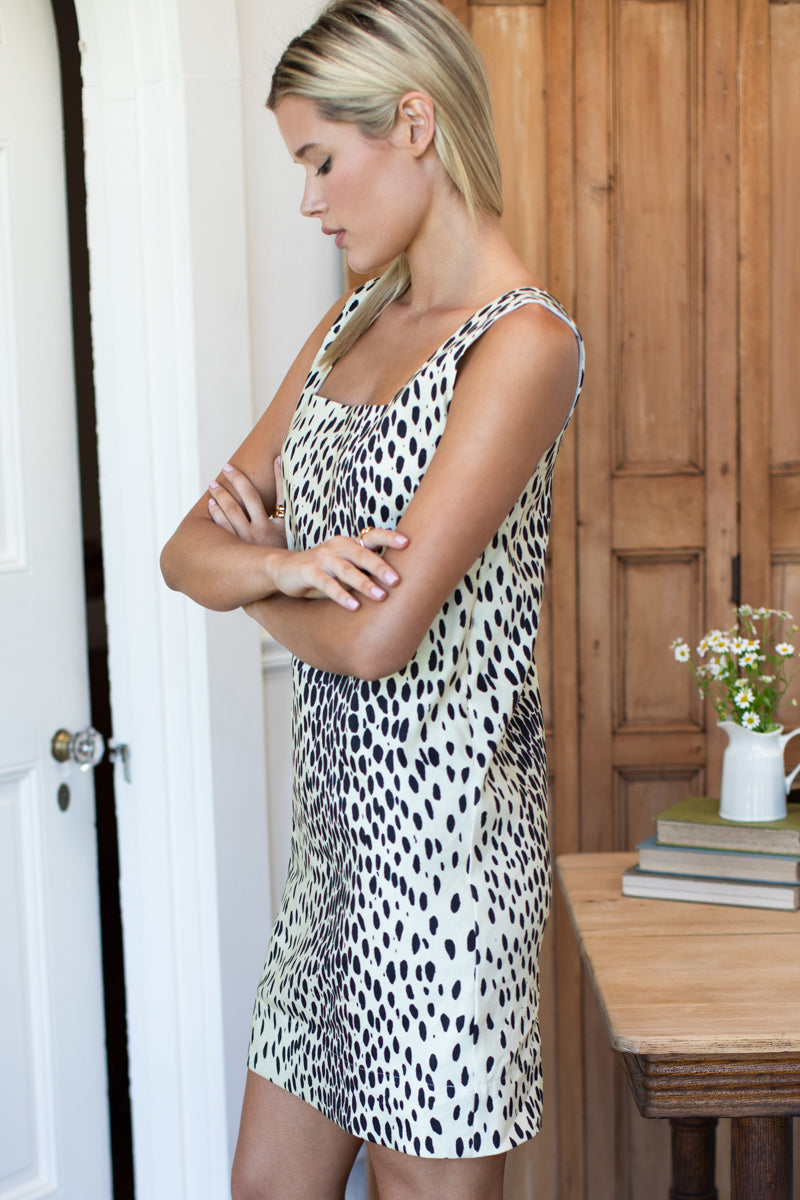
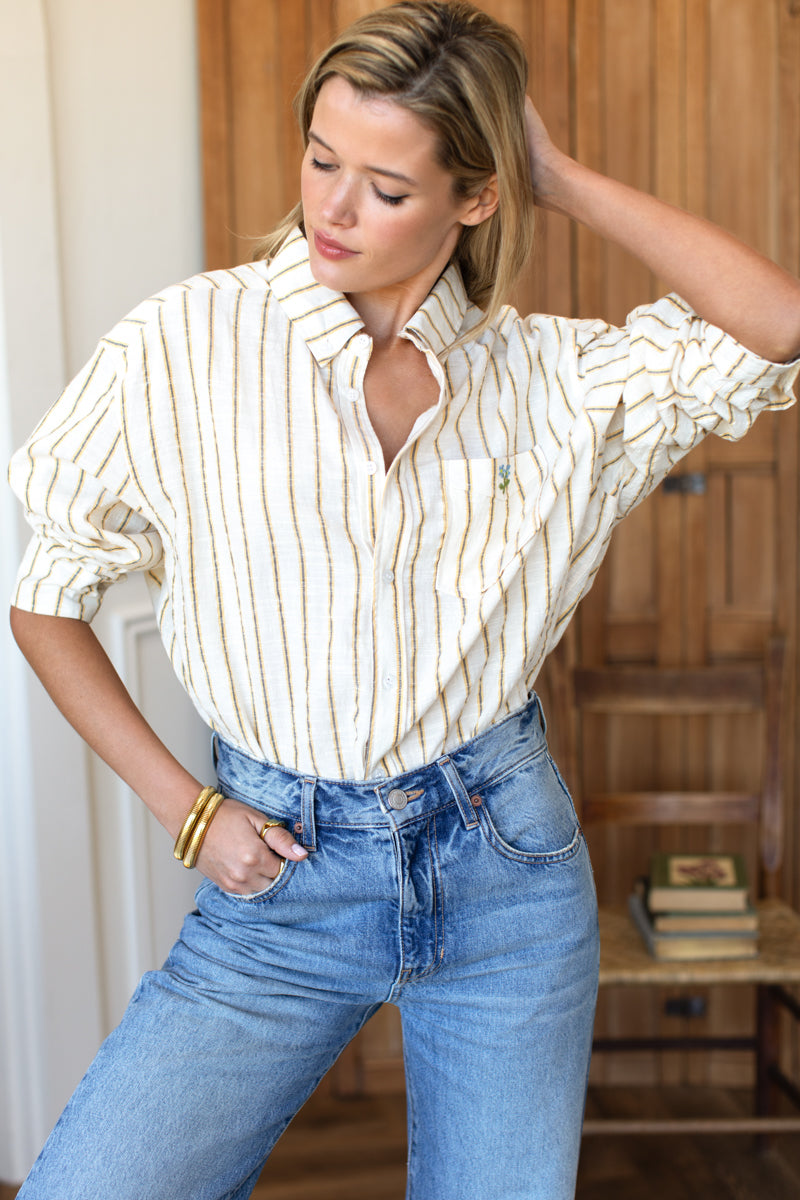
M1 — "The Blonde / Atelier + Coastal" (Current dominant, both modes)
- Internal descriptor: young woman (likely mid-20s), sandy/honey-blonde hair shoulder-to-collarbone length, frequently worn straight with side or center part, sometimes low loose bun. Heart-shaped face, full lips, blue-grey eyes, fair-but-sun-touched complexion, slim slight-petite build, ~5'7" feels.
- Mode coverage: Mode A (Main EF) + Mode B (Love Tòmas). Spans both.
- Setting coverage: intimate NH/Maine atelier interior (white wainscoting, arched bookshelves, herringbone wood) AND outdoor coastal/farm-stand/dock contexts.
- Styling signature: sleeveless or short-sleeve dresses/tops; tan leather slides or cognac sandals; minimal jewelry (single ring + small gold hoops); often holding a French market basket; sun-touched skin in outdoor shots, paler in interior. Sunglasses (black wayfarer-style) in some Love Tòmas outdoor shots.
- Reference image URLs (10+):
- https://cdn.shopify.com/s/files/1/1229/3334/files/EmersonFry-MixedHeirloomLaces_01.jpg — strawberries-on-table, white eyelet shift
- https://cdn.shopify.com/s/files/1/1229/3334/files/EmersonFry-MixedHeirloomLaces_03.jpg — white eyelet blouse, "vase" artwork backdrop
- https://cdn.shopify.com/s/files/1/1229/3334/files/EmersonFry-MixedHeirloomLaces_07.jpg — seated at oak table, white eyelet dress, tan slides
- https://cdn.shopify.com/s/files/1/1229/3334/files/EmersonFry-MixedHeirloomLaces_13.jpg — white eyelet blouse, hand-on-neck pose
- https://cdn.shopify.com/s/files/1/1229/3334/files/EmersonFry-MixedHeirloomLaces_15.jpg — seated at oak table, white eyelet dress
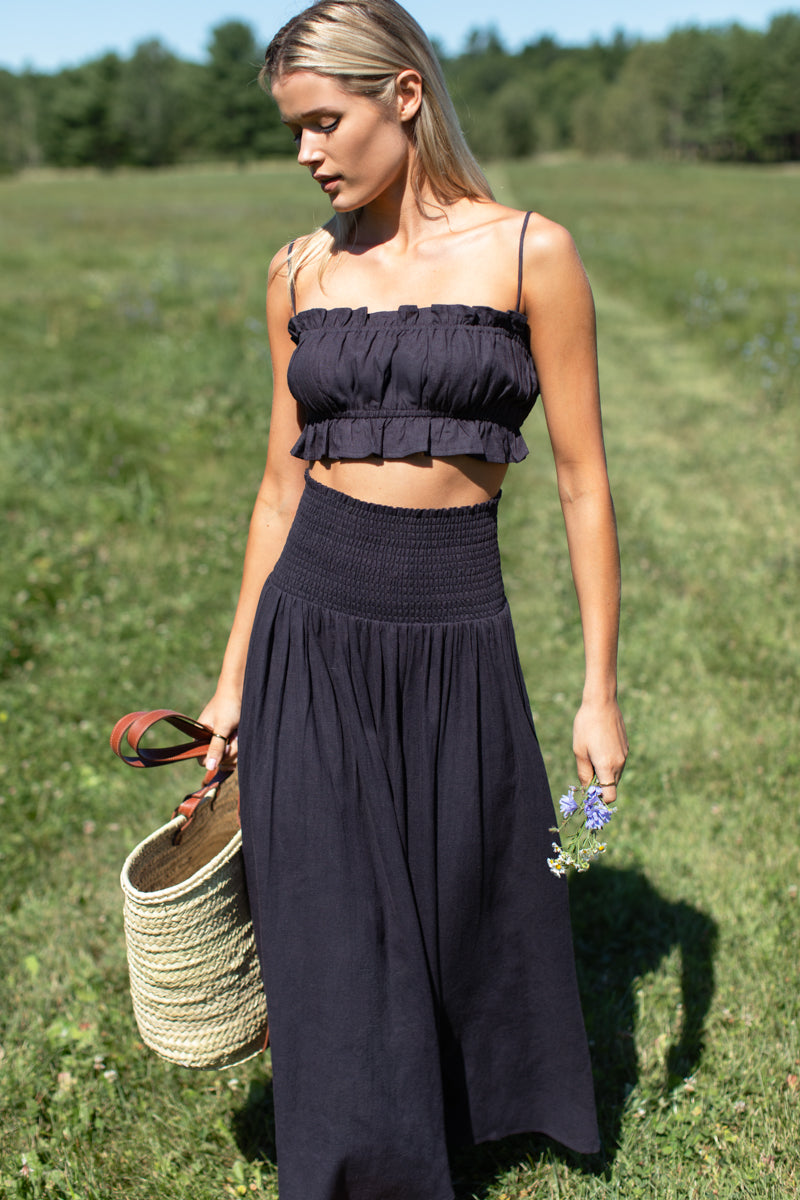
- https://emersonfry.com/cdn/shop/files/EmersonFry-SmockedMaxiSkirt-Midnight4-7_da298c74-9c00-44a0-b00d-6a713a140a55_1024x.jpg — grass field, black smocked LT set, French market basket, blue flowers
- https://emersonfry.com/cdn/shop/files/EmersonFry-LoveTomas-Skirts-SmockedMaxiSkirt-FanFlowersMarigold-1-2_1024x.jpg — straw sunhat, farm-stand, marigold floral LT set
- https://emersonfry.com/cdn/shop/files/EmersonFry-VacationTop-FanFlowersMarigold-2b_1b39d658-eb7e-44d7-bd17-86cc7c821422_1024x.jpg — close 3/4 portrait, marigold print
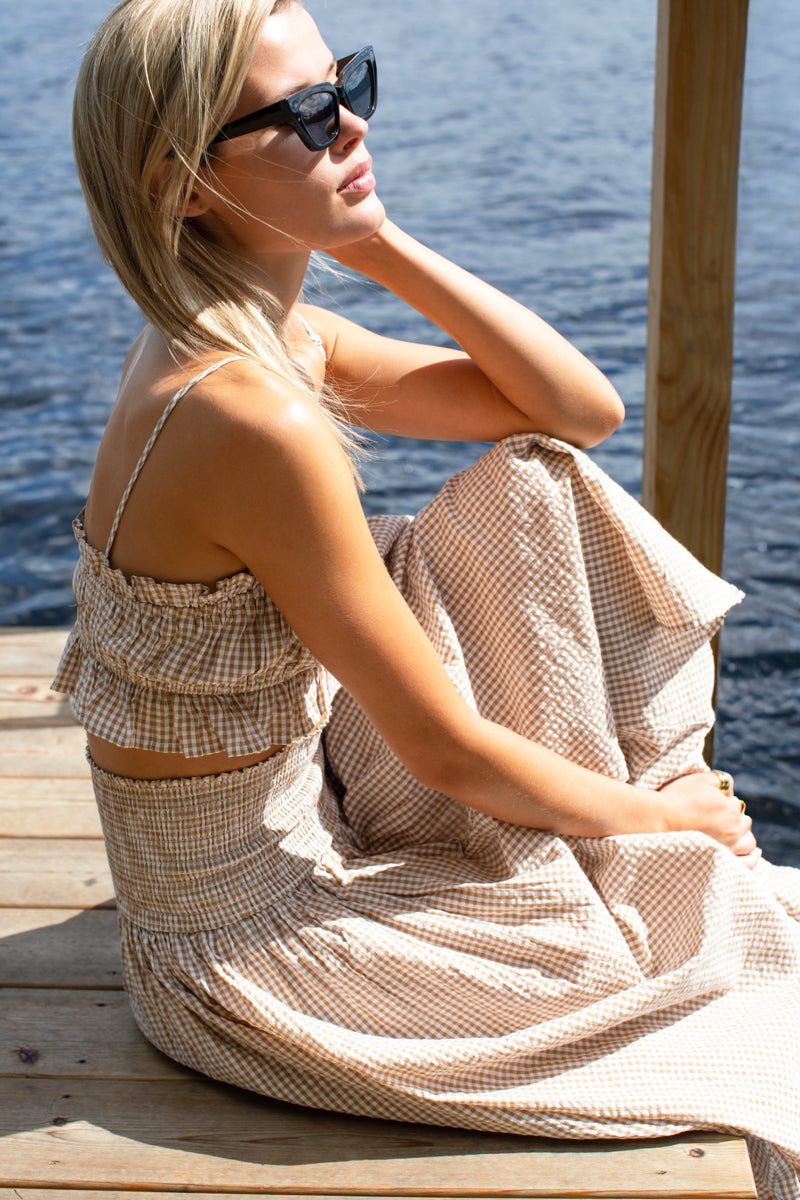
- https://emersonfry.com/cdn/shop/files/EmersonFry-VacationTop-CafeCheck4-12_1024x.jpg — sitting on dock, sunglasses, lake background
- https://emersonfry.com/cdn/shop/files/EmersonFry-SmockedMaxiSkirt-CafeCheck3-1_1024x.jpg — interior, holding French market basket
- https://emersonfry.com/cdn/shop/files/EmersonFryBastilleShortDress-StarWhite-1_1024x.jpg — white linen Bastille, sunglasses, farm-stand backdrop
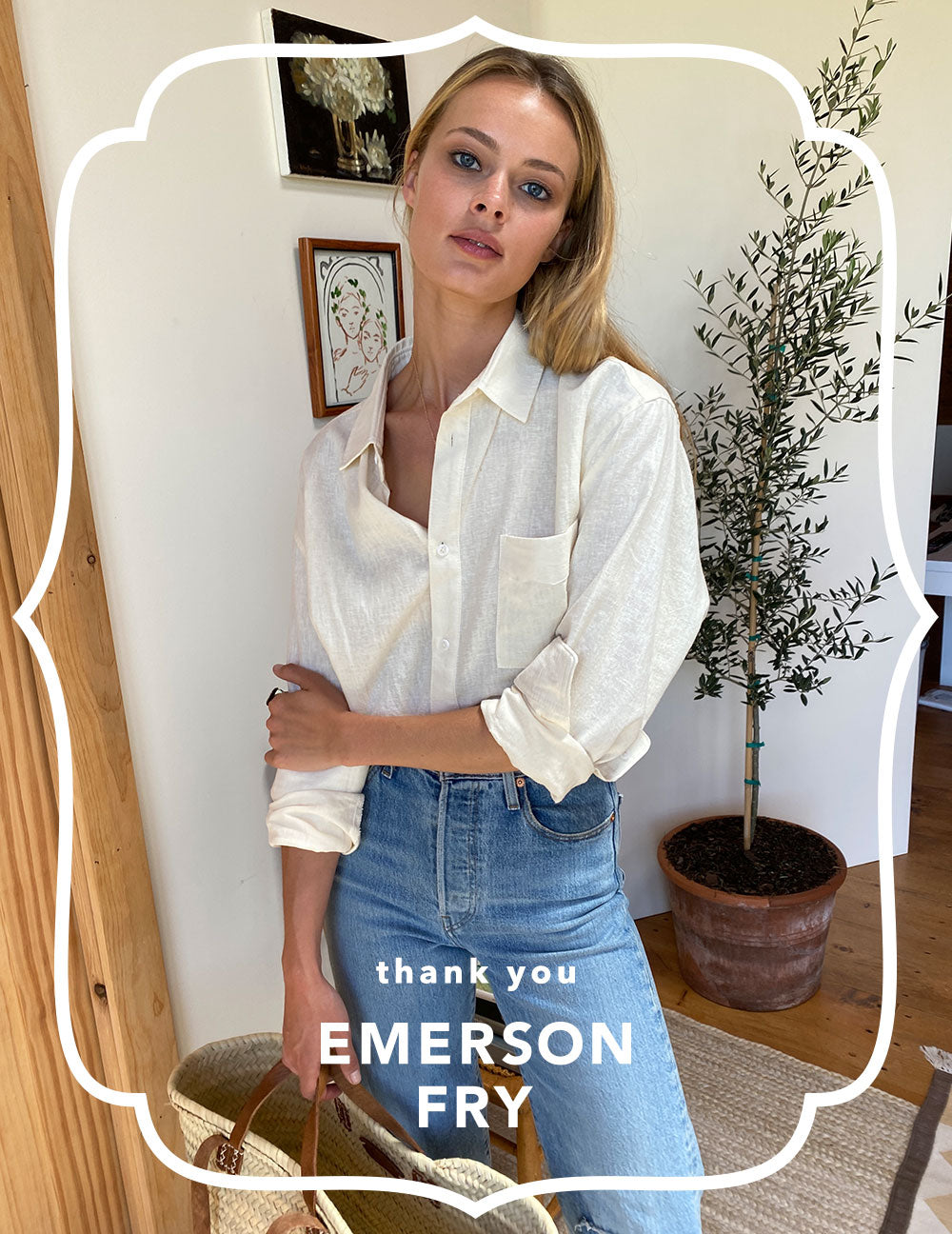
- https://emersonfry.com/cdn/shop/files/EmersonFry-RyanShirt-WhitePoplin_09.jpg — torso shot, "thank you Emerson Fry" overlay
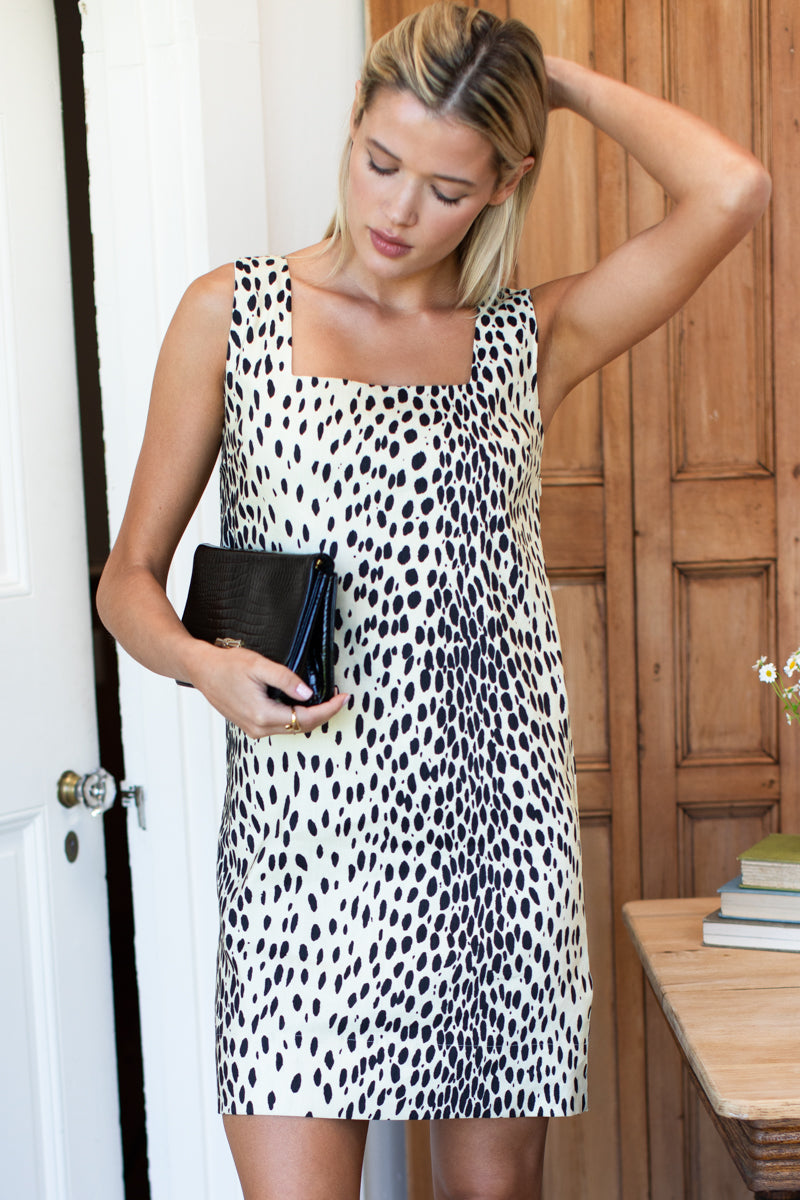
- https://emersonfry.com/cdn/shop/files/EmersonFry-RomaShiftDress2-LeopardLinen-7b_40f232f6-e5f5-4e08-bdc5-ae9c4bd6ed6a_1024x.jpg — leopard print Roma, interior
- https://emersonfry.com/cdn/shop/files/EmersonFry-RomaShiftDress2-LeopardLinen-4b_2947d7ce-3e48-43b2-a381-d4223bbd2f75_1024x.jpg — leopard print Roma, profile
- https://emersonfry.com/cdn/shop/files/EmersonFry-RyanShirt-GoldenStripe2-1_1024x.jpg — golden-stripe Ryan shirt, denim, indoor
- Approximate appearance count site-wide: ~15-20+ distinct product/shoot pages (high confidence)
- Confidence on "same person across all of these": HIGH (strong feature consistency: heart-shaped face, full lips, blue-grey eyes, sandy-blonde hair, slim build); recurring tells include slight skin texture/freckling under eyes, specific gold-hoop earrings, single ring on right hand.






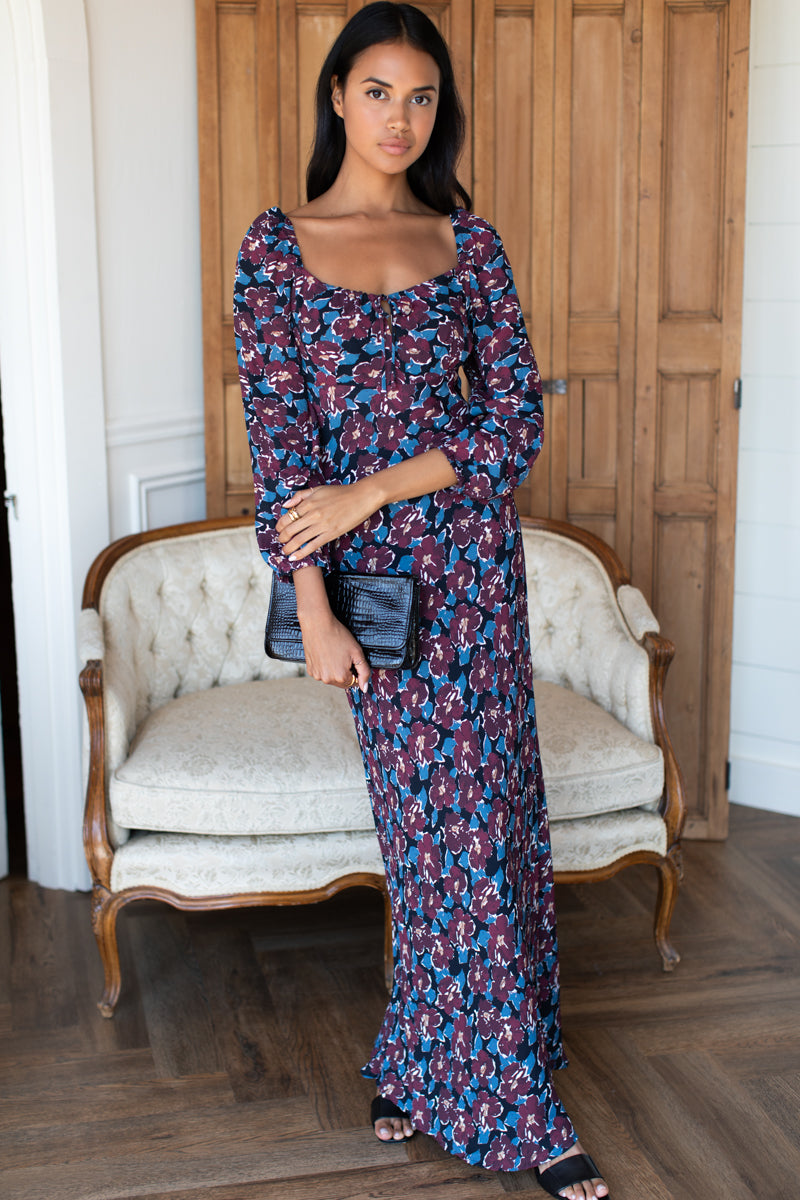
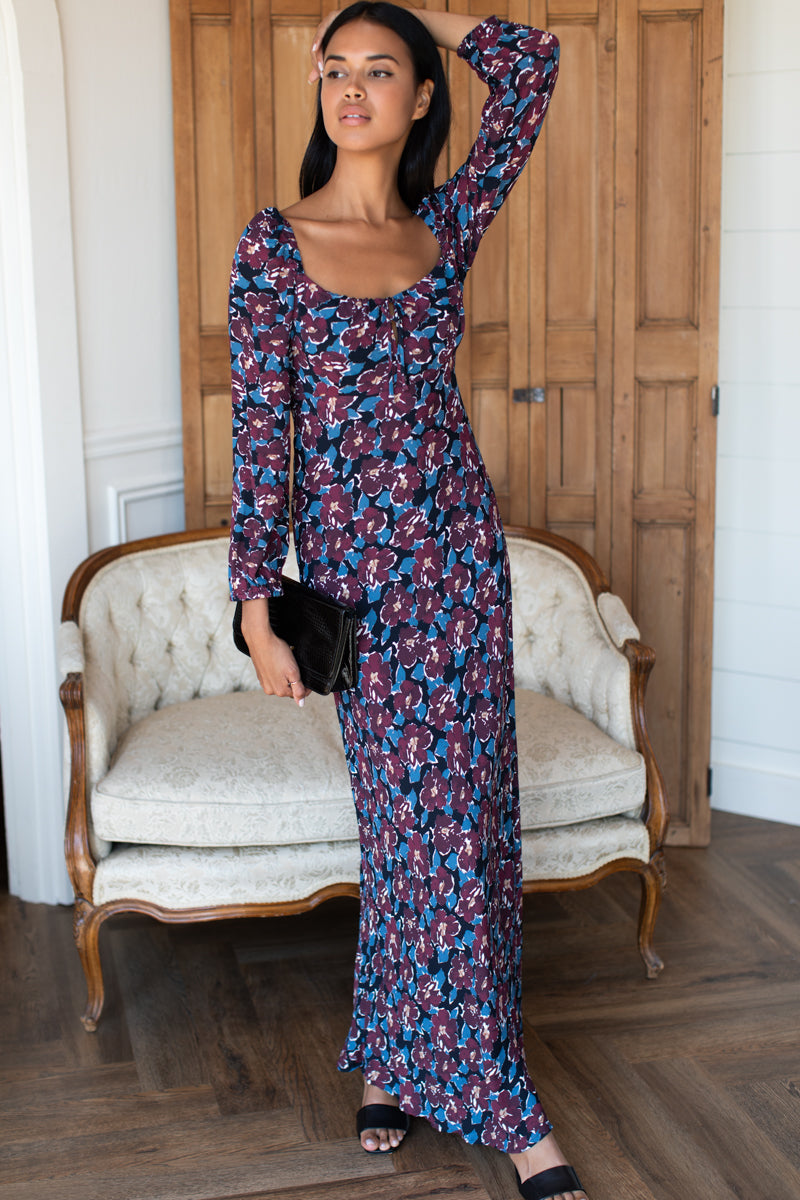
M2 — "The Brunette / Sleek-Bun" (Current dominant, both modes)
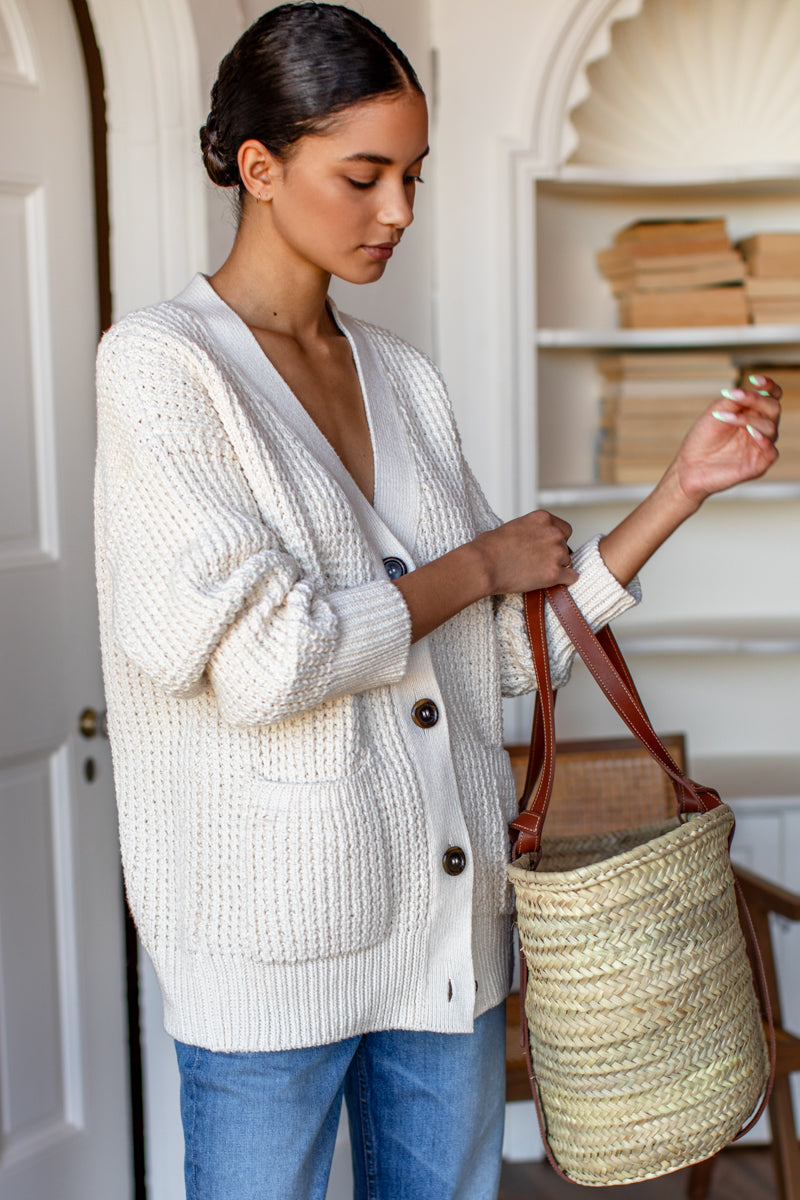
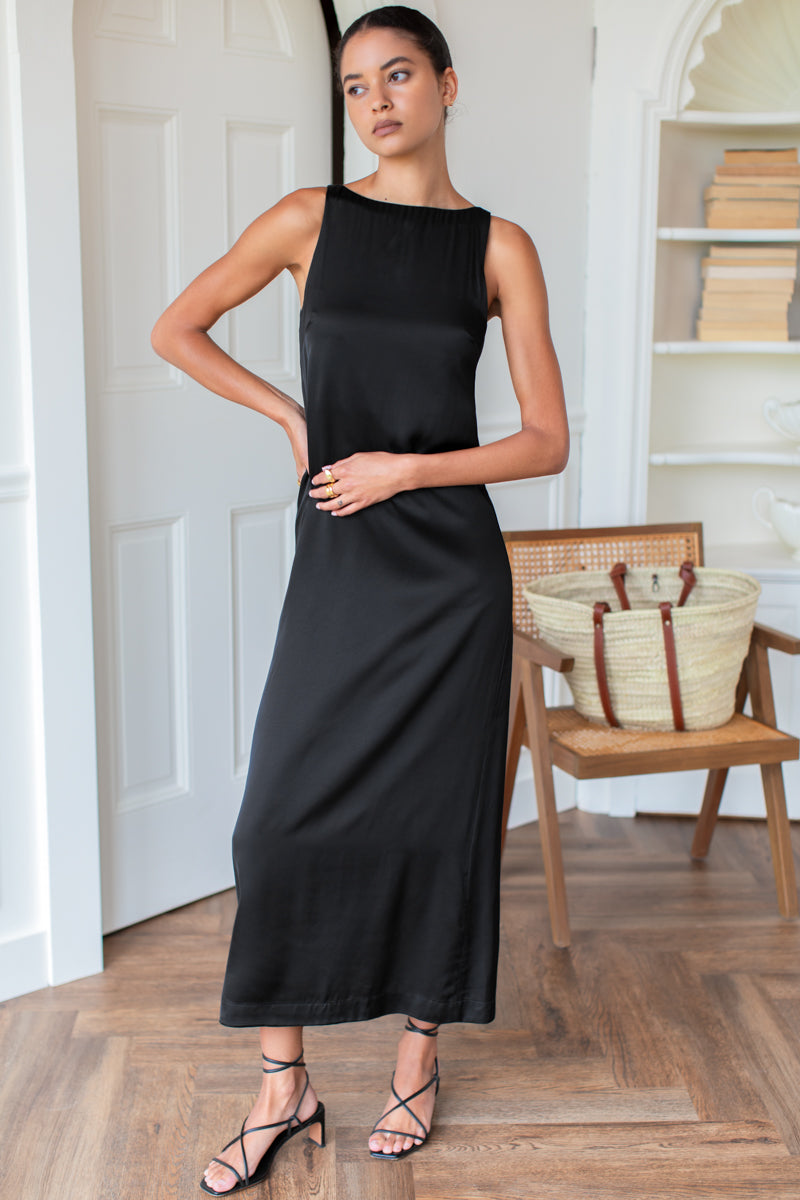
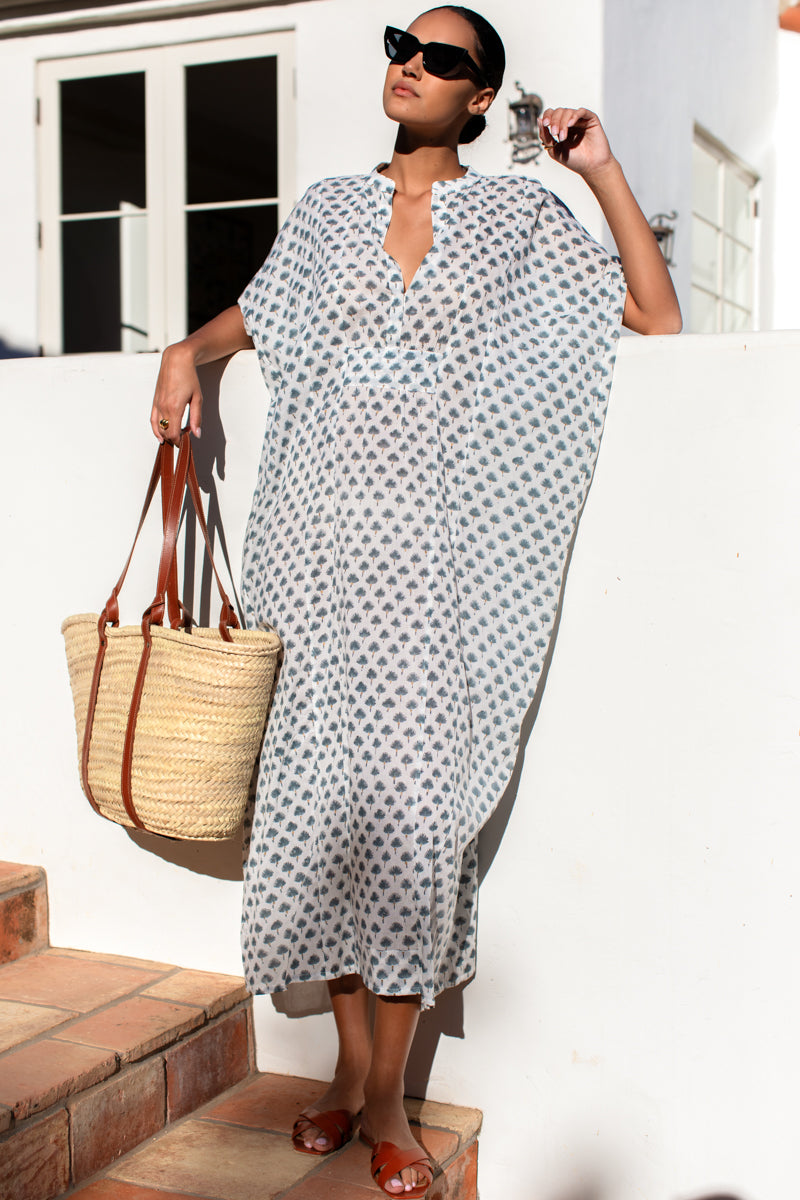
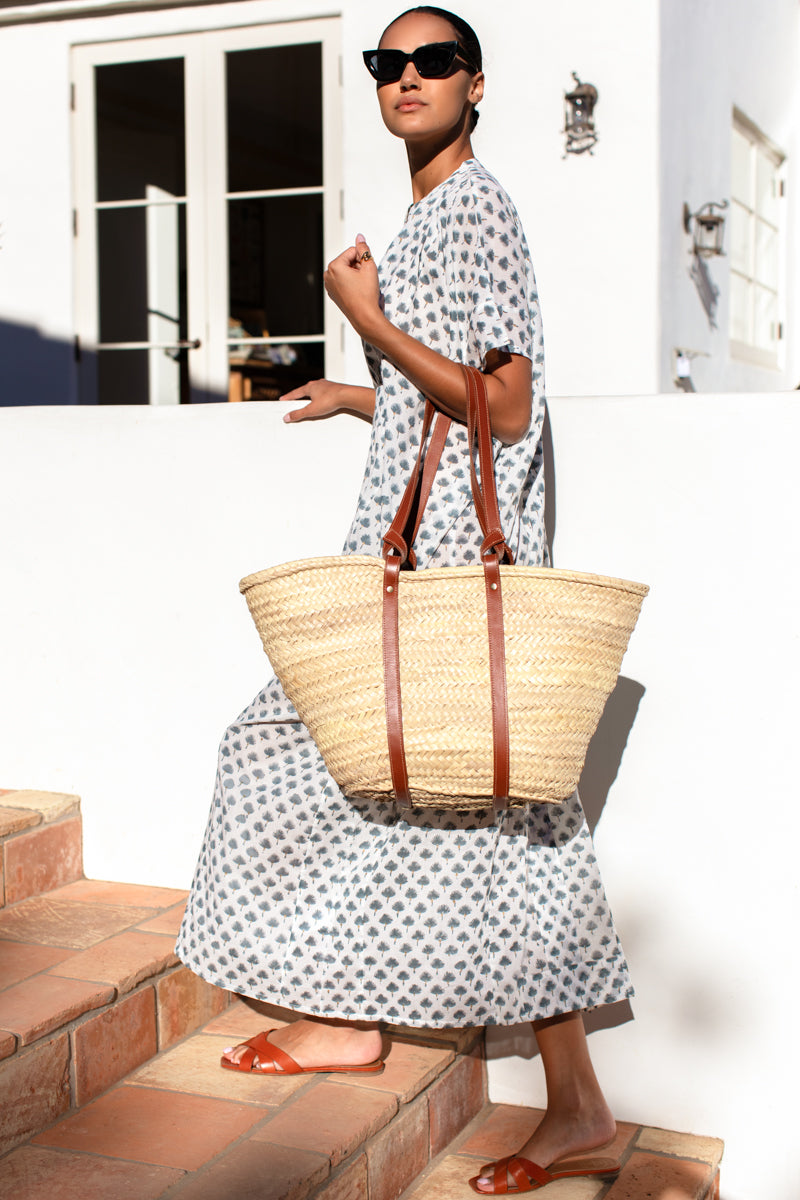
- Internal descriptor: young woman (likely mid-to-late-20s), long dark-brown to near-black hair worn pulled into a sleek low bun OR long braid OR low ponytail. Oval face, medium-fair complexion (reads Mediterranean / South Asian / mixed-heritage), dark eyes, soft full features, slim slight-medium build. Often wearing small gold hoops + single gold ring on right hand.
- Mode coverage: Mode A (Main EF) + Mode B (Love Tòmas). Spans both.
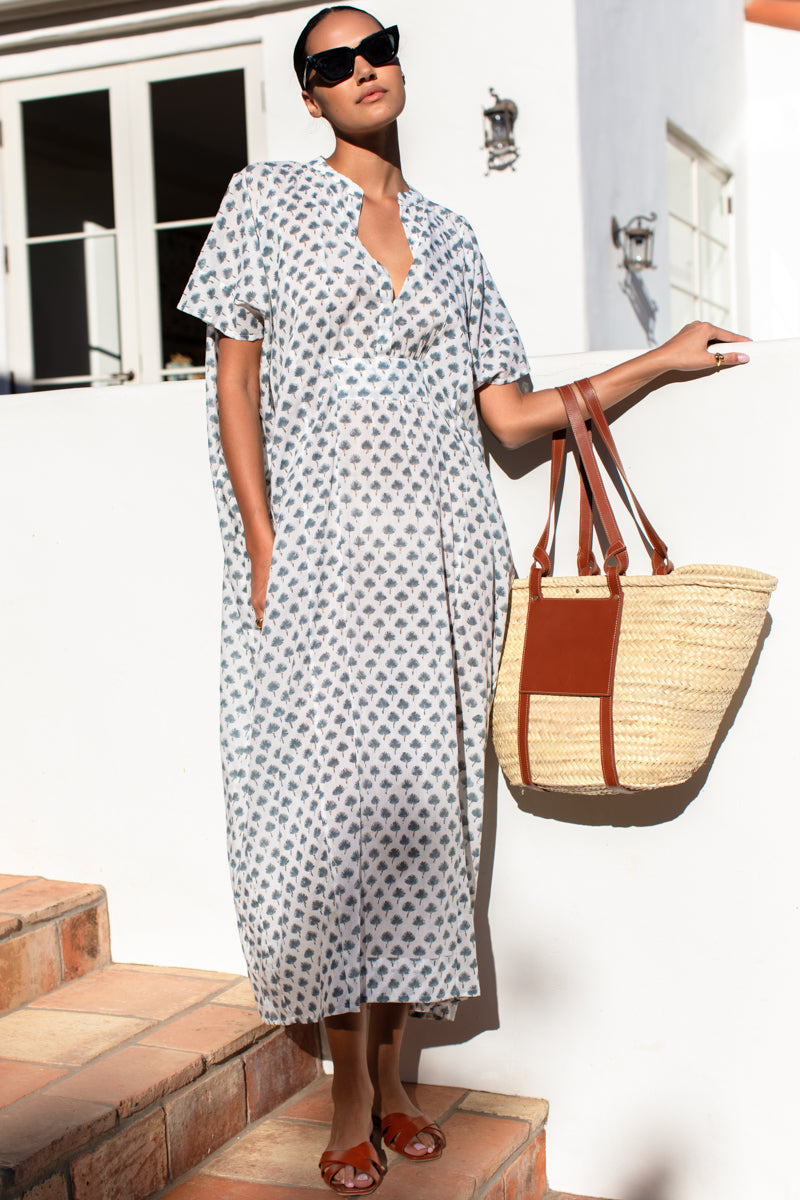
- Setting coverage: intimate NH/Maine atelier interior (same studio as M1) PLUS outdoor whitewashed-villa courtyard context (the Cleo caftan shoot — Mediterranean / Spain / Mallorca-style).
- Styling signature: sleeveless tops/dresses or long-sleeve gathered shapes; black suede slides or pointed black slingbacks; sleek pulled-back hair makes neckline + jaw the visual emphasis; often photographed in 3/4 profile or looking down/sideways (rarely full-front gaze). Sunglasses (large black square) when outdoor.
- Reference image URLs (10+):
- https://cdn.shopify.com/s/files/1/1229/3334/files/EmersonFry-RougeRedCozyFall_01.jpg — burgundy/rouge sleeveless lace, antique dresser, candles
- https://cdn.shopify.com/s/files/1/1229/3334/files/EmersonFry-RougeRedCozyFall_03.jpg — long braid down back, burgundy lace, looking away
- https://cdn.shopify.com/s/files/1/1229/3334/files/EmersonFry-RougeRedCozyFall_05.jpg — burgundy lace, holding candle + dish
- https://cdn.shopify.com/s/files/1/1229/3334/files/EmersonFry-CocoaCreamRusticDress_01.jpg — gingham puff-sleeve maxi, 3/4 back
- https://cdn.shopify.com/s/files/1/1229/3334/files/EmersonFry-CocoaCreamRusticDress_07.jpg — gingham smocked square-neck maxi, antique sideboard
- https://cdn.shopify.com/s/files/1/1229/3334/files/EmersonFry-CocoaCreamRusticDress_09.jpg — gingham puff-sleeve, holding candlestick, "we love making heirloom clothing for you" overlay
- https://cdn.shopify.com/s/files/1/1229/3334/files/EmersonFry-LayeringJackets1_01.jpg — camel wool overcoat, jeans, brown boots, outdoor "Frankie + Lou" awning
- https://cdn.shopify.com/s/files/1/1229/3334/files/EmersonFry-LayeringJackets1_05.jpg — camel wool overcoat, holding magazine
- https://cdn.shopify.com/s/files/1/1229/3334/files/EmersonFry-LayeringJackets1_09.jpg — black wool overcoat, seated outdoor café
- https://cdn.shopify.com/s/files/1/1229/3334/files/EmersonFry-RyanShirt-WhitePoplin_05.jpg — white Ryan poplin + black midi pencil skirt
- https://emersonfry.com/cdn/shop/files/EmersonFry-CozyCottonCardigan-IvoryTanguisCotton-8_1024x.jpg — ivory cardigan, French market basket
- https://emersonfry.com/cdn/shop/files/EmersonFryCutInShiftMaxiDressBlack-2_1024x.jpg — black satin cut-in maxi
- https://emersonfry.com/cdn/shop/files/EmersonFryFrannyBiasDress2-WildersFlowersMerlot2-2_1024x.jpg — Wilders Flowers floral bias maxi
- https://emersonfry.com/cdn/shop/files/EmersonFryFrannyBiasDress2-WildersFlowersMerlot2_1024x.jpg — same dress, gold settee backdrop
- https://emersonfry.com/cdn/shop/files/EmersonFryEmersonCaftanCleoOrganic2.jpg — Cleo print caftan, whitewashed villa courtyard, sunglasses
- https://emersonfry.com/cdn/shop/files/EmersonFryEmersonCaftanCleoOrganic3-4.jpg — Cleo caftan, side profile with French market basket
- https://emersonfry.com/cdn/shop/files/EmersonFryEmersonCaftanCleoOrganic3-6.jpg — Cleo caftan, full standing
- Approximate appearance count site-wide: ~15-20+ distinct product/shoot pages (high confidence)
- Confidence on "same person across all": HIGH for the atelier-interior shots (very consistent features: oval face, sleek dark hair pulled back, soft lip line, ring on right hand). MEDIUM-HIGH for the villa/sunglasses Cleo-caftan shots (sunglasses obscure features; jaw/lips/hair match).


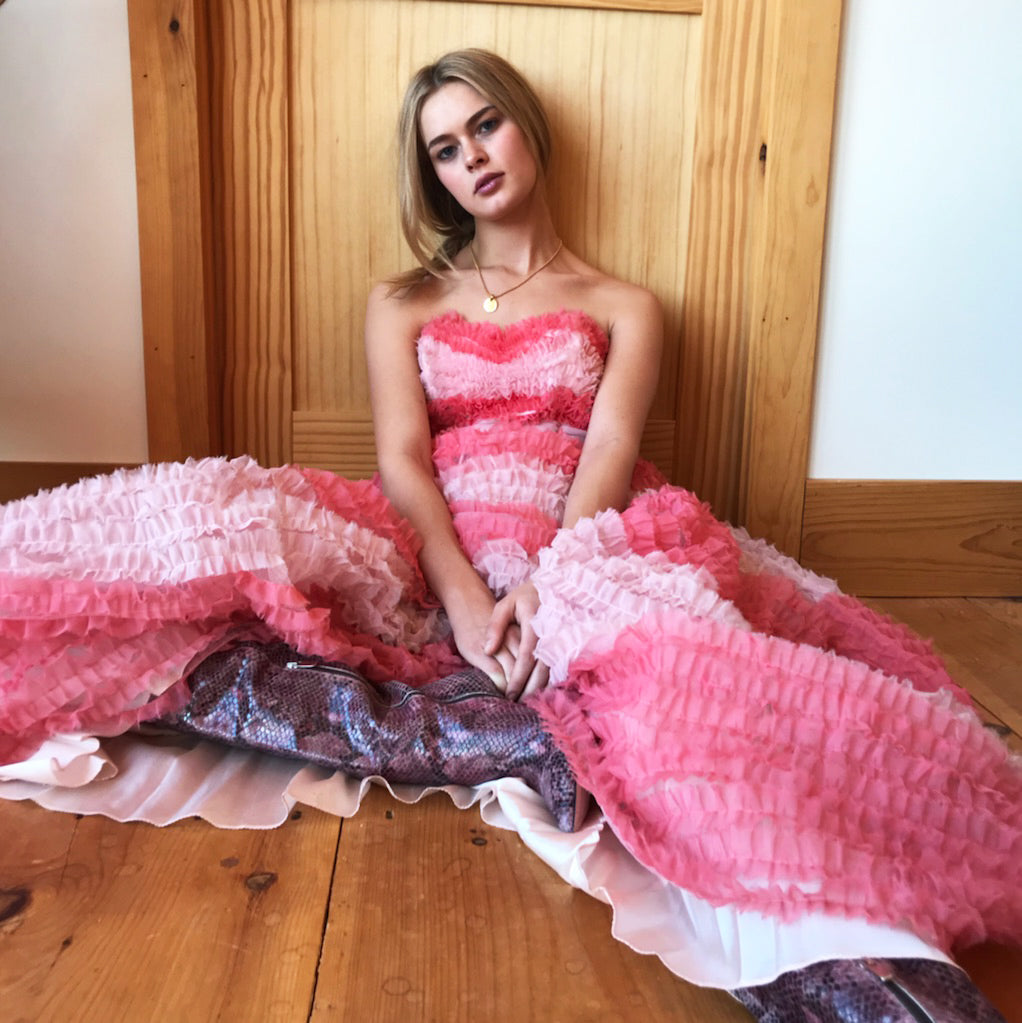
M3 — "Anna" (Historic, 2017-2019 era, primarily Main EF)
- Source labeling: EF blog post
flowergirl(Dec 2017) reads "shooting Anna in EF and archive VTG this week" + image filenamesemerson-fry-e-anna-big-fur-coat-flower-dress.jpg. Direct source labeling. - Internal descriptor: young woman, mid-20s-ish, blonde-light-brown hair worn straight and pulled back/away from face, oval face, fair complexion, slim build, "all-American-blonde" features. More relaxed posing than current models.
- Mode coverage: Primarily Mode A (Main EF). Some Love Tòmas.
- Setting coverage: intimate NH atelier interior (same wood-floored loft visible in current shoots). Often paired with vintage archive pieces.
- Styling signature: vintage layering (fur coats over floral skirts, tulle, sequin). Statement boots.
- Reference image URLs:
- https://emersonfry.com/cdn/shop/articles/emerson-fry-e-anna-big-fur-coat-flower-dress.jpg — fur coat + floral skirt + purple snake boots (
/blogs/happening/flowergirlDec 2017) - https://emersonfry.com/cdn/shop/articles/emerson-fry-e-pink-tulle-e.jpg — pink tulle ruffled dress, seated on wood floor (
/blogs/happening/for-the-loveDec 2017)
- https://emersonfry.com/cdn/shop/articles/emerson-fry-e-anna-big-fur-coat-flower-dress.jpg — fur coat + floral skirt + purple snake boots (
- Approximate appearance count site-wide: ~4-8 (older era — many older posts lost or de-indexed; lower confidence on total count)
- Confidence on identification: MEDIUM-HIGH — EF named her directly in their blog. Several other 2017-2019 era posts feature what appears to be the same person; can be confirmed with closer manual review of older blog imagery.

M4 — "Georgie / G" (Historic, 2017-2018 era, mixed mode)
- Source labeling: EF blog posts
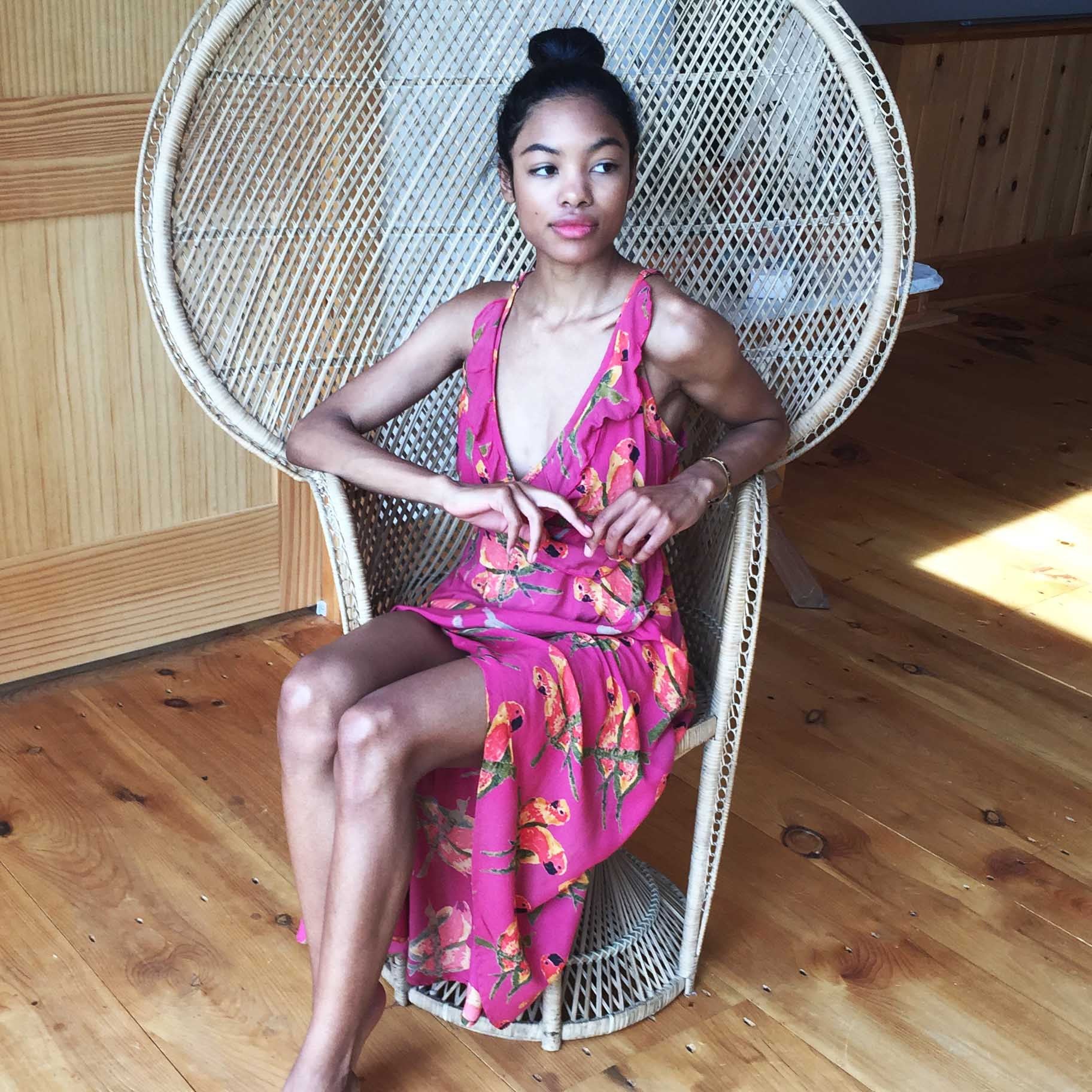
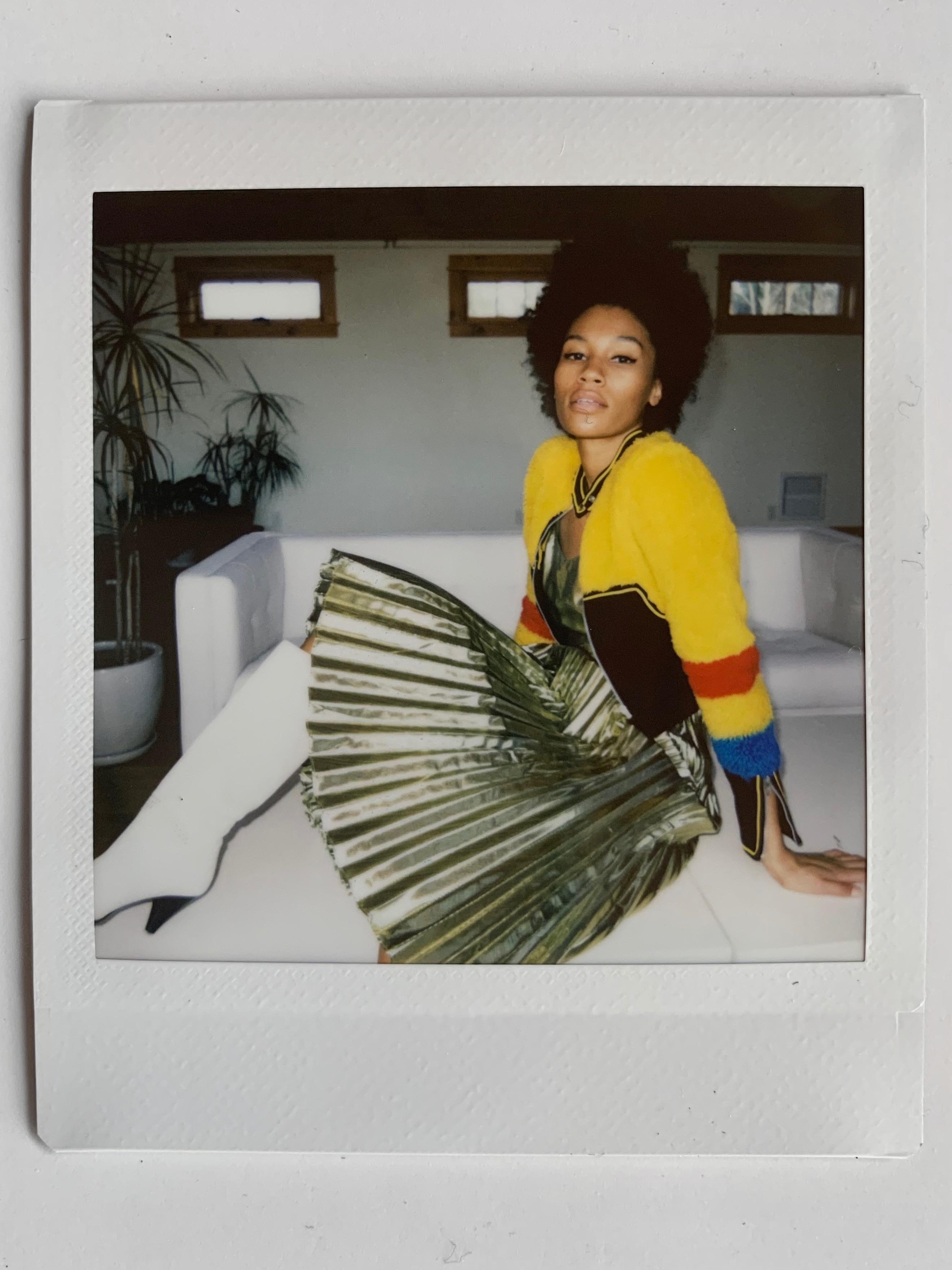
georgie-in-parrot-dress(July 2017),g-in-lou-boot-gold(Dec 2018). Direct EF labeling — first name + initial. - Internal descriptor: young Black woman, mid-20s, dark hair worn either pulled into a top bun or natural Afro, slim build, warm dark-brown complexion, expressive features, slight smile in some shots, languid posing.
- Mode coverage: Mode B (Love Tòmas, parrot print dress) + Mode A (Lou boots in gold).
- Setting coverage: intimate NH/Maine atelier interior (wood floors, peacock chairs, white sofa).
- Styling signature: statement print dresses, vintage cardigans, white knee-high boots, peacock-chair seating, distinctive polaroid-style aesthetic in some shots.
- Reference image URLs:
- https://emersonfry.com/cdn/shop/articles/emerson-fry-fred-parrot-dress2.jpg — hot-pink parrot dress, peacock chair (
/blogs/happening/georgie-in-parrot-dressJul 2017) - https://emersonfry.com/cdn/shop/articles/emerson-fry-blog-G-in-gold2.jpg — yellow fur cardigan, metallic pleated skirt, white knee boots, polaroid-style framing (
/blogs/happening/g-in-lou-boot-goldDec 2018)
- https://emersonfry.com/cdn/shop/articles/emerson-fry-fred-parrot-dress2.jpg — hot-pink parrot dress, peacock chair (
- Approximate appearance count site-wide: ~5-10 (older era — limited surviving blog references; broader survey of pre-2020 product pages likely surfaces more)
- Confidence on identification: HIGH (directly named by EF), but count is undercounted by my scan because product imagery from her era has likely been replaced with newer photography on most current product pages.
- Note on photographer: the parrot-dress filename includes "fred-" — likely indicates Frédéric Fry, Emerson's husband (per public reporting on the brand), photographed her.
M5 — "C / Beautiful C" (Historic, ~2020-2021 era, primarily Main EF)
- Source labeling: EF blog post
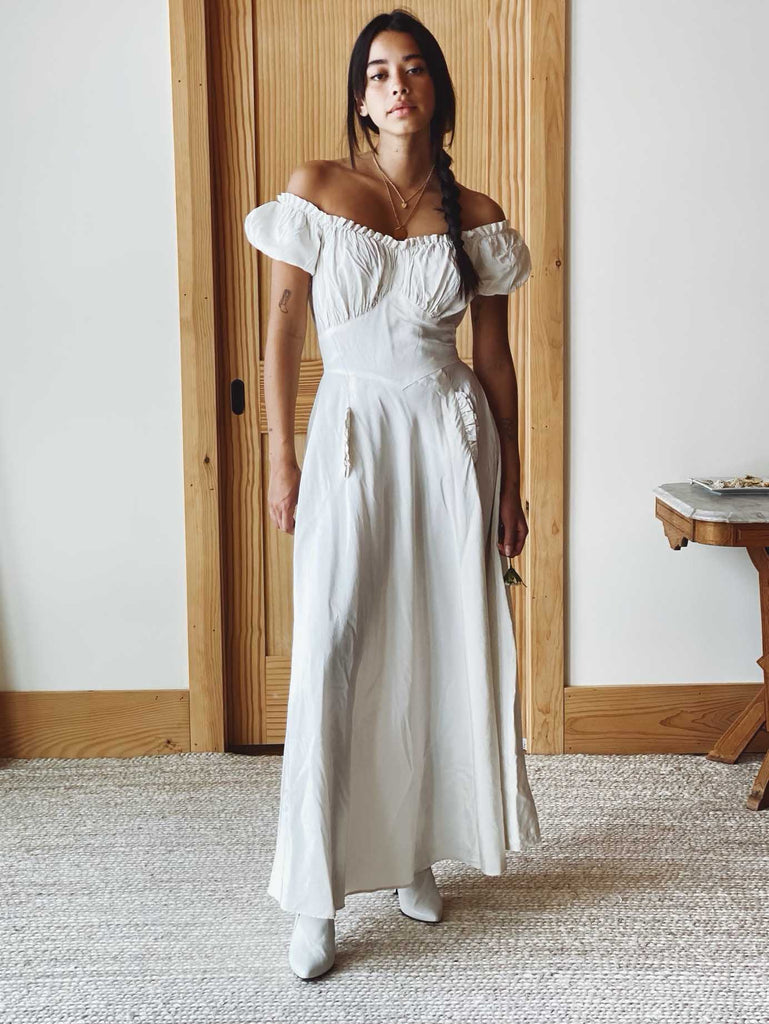
beautiful-c(Jan 2021) → "beautiful beautiful beautiful in the office this wk"; image filenamesbeautiful-c-3-emerson-fry.jpg,beautiful-C-2-emerson-fry.jpg. - Internal descriptor: young woman, mid-20s, long dark-brown hair often worn with a side braid, olive/tan complexion (Latina or mixed-heritage), oval face with prominent cheekbones, small tattoo on right forearm, slim build.
- Mode coverage: Mode A (vintage archive white dress) + likely Mode B (per related posts).
- Setting coverage: intimate NH atelier interior (same wood-floored, white-paneled studio).
- Styling signature: vintage archive pieces, off-shoulder silhouettes, white ankle boots, "shot in the office" feel.
- Reference image URLs:
- https://cdn.shopify.com/s/files/1/1229/3334/files/beautiful-c-3-emerson-fry_1024x1024.jpg — off-shoulder white vintage dress, full-length (
/blogs/happening/beautiful-cJan 2021)
- https://cdn.shopify.com/s/files/1/1229/3334/files/beautiful-c-3-emerson-fry_1024x1024.jpg — off-shoulder white vintage dress, full-length (
- Approximate appearance count site-wide: ~3-6 (limited surviving references)
- Confidence on identification: MEDIUM — directly named by EF as "C" but only 1-2 distinct visible images surface in current site scan; would need to check older
/cdn/shop/articles/paths or Instagram archive for more.
M6 — "J" (Historic, ~2018-2020 era, primarily Main EF)
- Source labeling: EF blog posts
j("beautiful J in the office with CBB!" Aug 2020),beautygirl-in-a-white-dress-from-our-vtg-archives(Sep 2018, filenameJ-in-vintage1.jpg). - Internal descriptor: young woman, olive/tan complexion, long dark hair often with side braid, slim build. Visually similar to C — would need deeper review to determine if "J" and "C" are the same person with different captions, or two different models with similar look.
- Mode coverage: Mode A.
- Setting coverage: intimate NH atelier interior, "office" / studio context.
- Reference image URLs:
- https://emersonfry.com/cdn/shop/articles/IMG_1467.JPG — pink tulle ruffled dress, seated on wood floor (
/blogs/happening/jAug 2020)
- https://emersonfry.com/cdn/shop/articles/IMG_1467.JPG — pink tulle ruffled dress, seated on wood floor (
- Approximate appearance count site-wide: ~3-5
- Confidence on identification: MEDIUM — named by EF, but visually similar to C; deserves a closer second look to disambiguate.

M7 — "Elise T" (Historic, ~2019 era, primarily Main EF)
- Source labeling: EF blog post
thinking-on-blues(Dec 2019) → "thinking on blues for u and Elise t in white is <3 <3 <3"; image filenameemerson-fry-elise-t-white-2.JPG. - Internal descriptor: insufficient visible imagery — only a torso-cropped mirror selfie. Cannot identify face. Fair-skinned hand visible.
- Reference image URLs:
- https://emersonfry.com/cdn/shop/articles/emerson-fry-elise-t-white-2.JPG — torso-only mirror selfie, white embroidered shirt + jeans
- Confidence on identification: LOW — cannot characterize without more imagery.

M8 — "Emerson herself" (Founder / 2016-2022 era, both modes, mirror-selfie style)
- Source labeling: Emerson Fry, founder/designer. Image filenames:
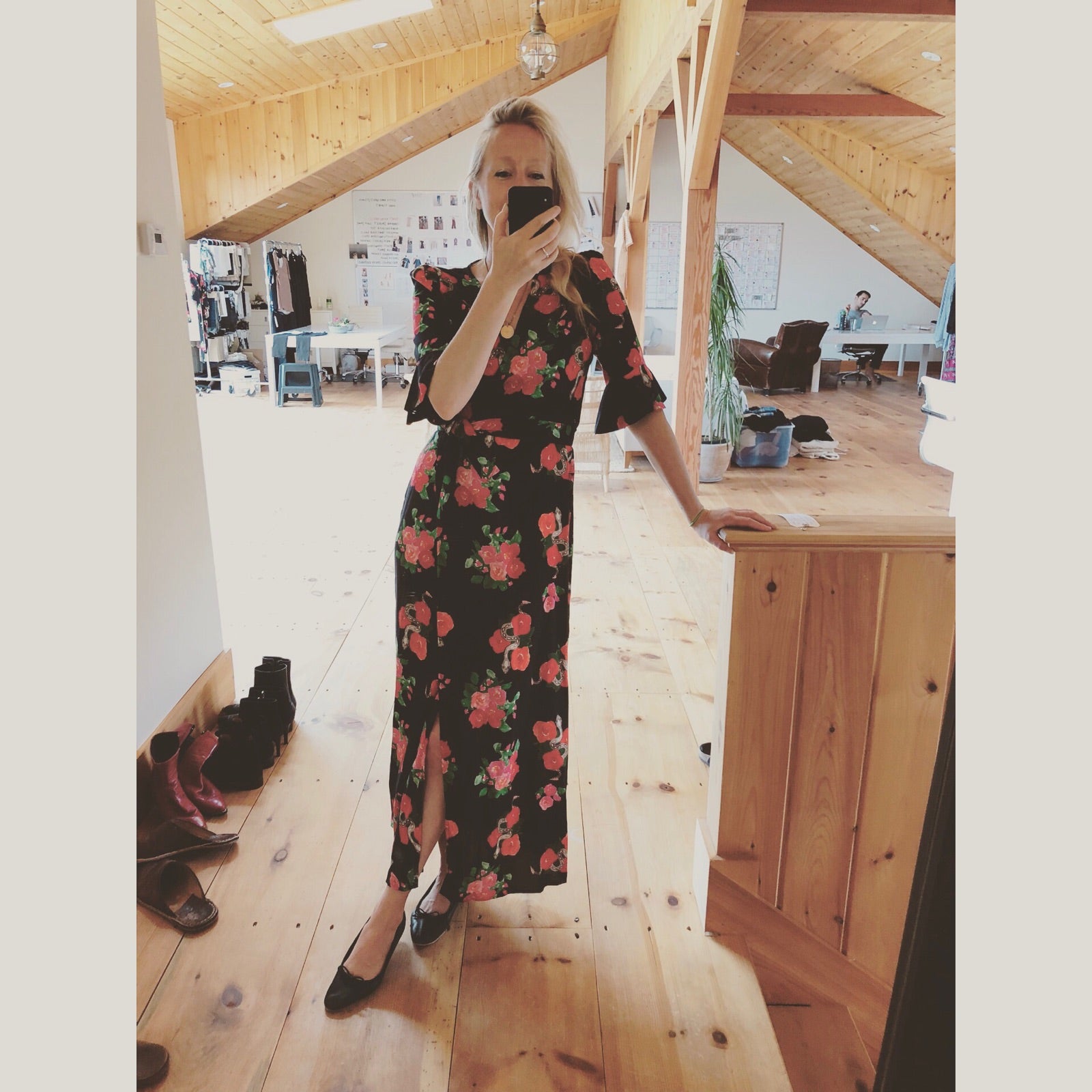
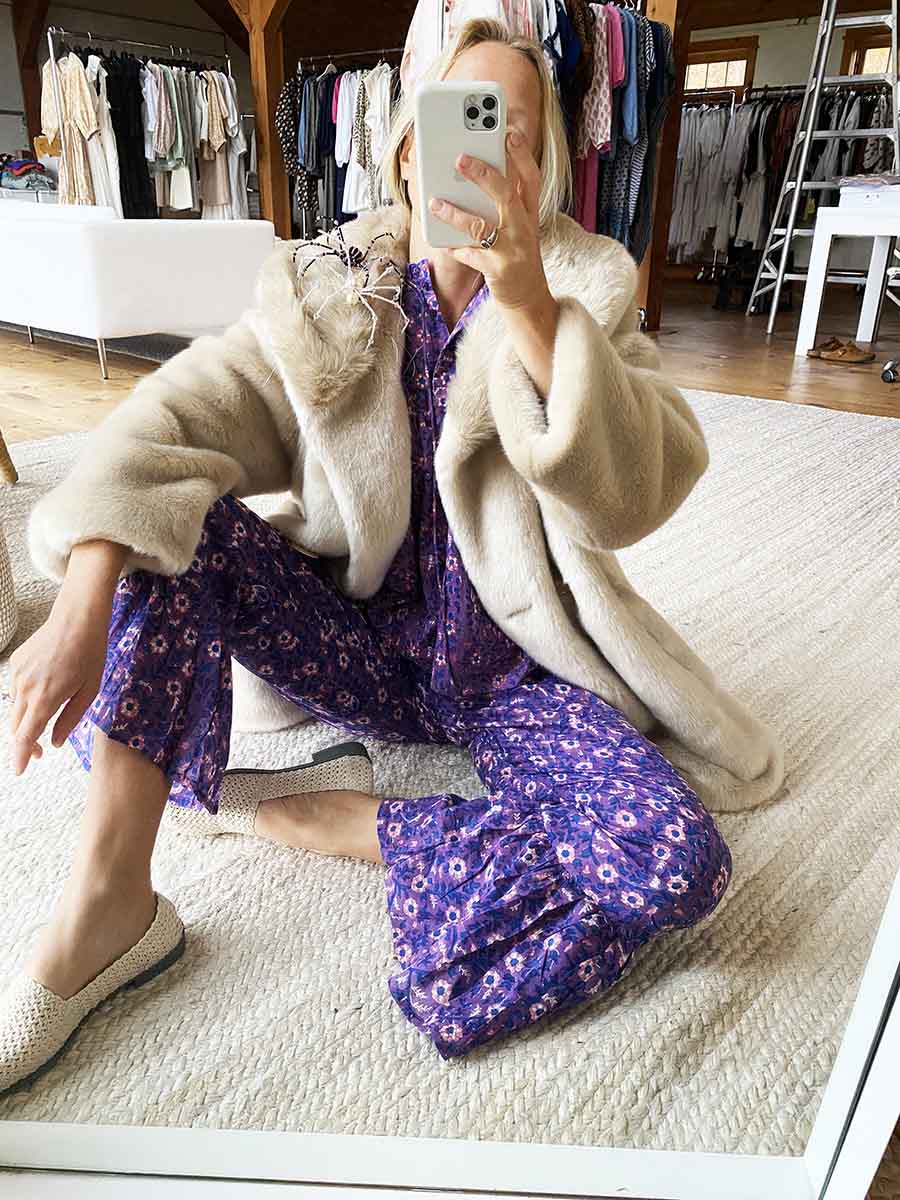
emerson-wearing-wild-roses.jpeg,emerson-fry-e-trying-stuffon1.jpg,emerson-is-trying-stuff-on-wildflowers-1.jpg,emerson-fry-pink-looking-at-it2.jpg,e-tux-4.jpg,e-wild-horses2.jpg,emerson-fry-e-sisters-in-neckties.jpg. Blog posts signed "e." Public-facing founder of the brand. - Internal descriptor: woman, late 30s / 40s era of these shoots, blonde shoulder-length hair, fair complexion, slim build. Photographs are mostly mirror-selfies from the studio loft (atelier-life context, "trying stuff on for u") — a distinctly non-model aesthetic that's part of the brand's intimate / founder-voice feel.
- Mode coverage: Both modes, but typically in archive/vintage pieces or new samples being tested.
- Setting coverage: EF studio loft (open-plan, wood-floored, attic-style with vaulted ceiling, racks of clothing visible).
- Styling signature: mirror-phone-selfie aesthetic ("looking at this for u this wk"); founder voice; shot in atelier; full-length or 3/4.
- Reference image URLs:
- https://emersonfry.com/cdn/shop/articles/emerson-wearing-wild-roses.jpeg — red rose floral wrap dress, atelier mirror selfie (
/blogs/happening/wild-rosesMay 2018) - https://emersonfry.com/cdn/shop/articles/emerson-fry-e-trying-stuffon1.jpg — gingham handblock fete pant (
/blogs/happening/handblock-fete-pantNov 2020) - https://emersonfry.com/cdn/shop/articles/emerson-is-trying-stuff-on-wildflowers-1.jpg — wildflowers print, trying-on shot (
/blogs/happening/jeweledDec 2020) - https://cdn.shopify.com/s/files/1/1229/3334/files/emerson-fry-blog-e-sisters-in-neckties_1024x1024.jpg — clay-red necktie sisters shot (
/blogs/happening/sisters-in-clay-red-necktiesMar 2021)
- https://emersonfry.com/cdn/shop/articles/emerson-wearing-wild-roses.jpeg — red rose floral wrap dress, atelier mirror selfie (
- Approximate appearance count site-wide: ~15-25 across the 10-year blog history
- Special consent posture: This is the founder herself. Likeness rights are simpler since she is the brand principal — but generated imagery of her must still be approved by her personally before any use. Probably the highest-trust profile to build first because consent is immediate and self-contained.
- Confidence on identification: HIGH (founder; consistent self-labeling across her own brand).


Other recurring people surfaced but not model-class
- "R + T" — referenced in
business-trippost ("notebooks from a far away place long ago. somewhere on the border of nepal with R + T") — likely team/colleagues, not models. - "K" — referenced in
jeweledpost (jewelry collaborator). - "CBB" — referenced in
jpost ("J in the office with CBB!") — probably another colleague. - "Sharon" — referenced repeatedly in product print names ("Sharon's Flowers Gold") — likely a print designer, not a model.
- "Gia" — print design name (
gia_print), not a model.
These all surface in EF's tight-knit-family voice but are not photographed-as-models.
§2 Photography characteristics
Lighting
- Soft natural daylight only. No studio strobes. No hard shadows. No high-contrast.
- Window light is the primary source in interior shots (north-facing diffuse).
- Golden-hour or open-shade dominates outdoor shots.
- Warm color temperature throughout — slightly amber-biased, never cool/sterile.
Setting (two anchor environments)
- "The atelier" (interior, ~70% of contemporary shots):
- White wainscoting, paneled doors, arched bookshelves, sconces
- Herringbone medium-tone oak wood floors
- Antique wood dressers, French settees (cream brocade), wicker chairs
- Decorative objects: candles, pottery bowls, French market baskets, blue-painted dishes, dried flowers, small flower arrangements
- Reads NH or coastal-Maine farmhouse interior; intentionally not "studio"
- "The world" (exterior, ~30%):
- Grass field / wildflower meadow
- Lake dock + water
- Farm stand with vegetables/produce + green doors
- Whitewashed Mediterranean villa (Spain/Mallorca-style — used for Love Tòmas Vacation specifically)
- Outdoor café table on gravel with iron furniture
Color treatment
- Main EF (Mode A): warm tones, muted ivory/cream/black/cocoa/burgundy palette; never pushed saturation
- Love Tòmas (Mode B): warmer + slightly higher-saturated; ochre marigold + indigo + cream + cognac brown; outdoor sunlight pushes brightness but never blown out
- Universal: never cool-toned; never desaturated-monochrome; never over-graded
Composition
- Full-figure standing (~40%) — feet-to-head, often with hand on counter / dresser / chair
- 3/4 sitting at table or on bench (~30%) — usually looking down or sideways
- Half-body or 3/4 portrait (~15%) — close enough to read fabric texture
- Detail / styling-still-life (~15%) — shoes, jewelry, bag arrangements on wood; no model
- Camera position usually slightly below eye-line — gives models a slight pedestal feel
- Model gaze: down or sideways ~75% of the time; rarely direct front-camera. The site avoids the high-fashion "challenge-the-viewer" stare.
Mood
- Intimate, candid, contemplative. Never high-energy. Never laughing-out-loud. Never "lifestyle stock-photo happy."
- The model often appears as if mid-thought — pausing while arranging strawberries, lighting a candle, drinking coffee, looking at a magazine.
- Reads as personal moments, not as posed editorial.
Resolution / quality
- Current product page imagery (2024-2026): mostly 1024px-wide high-res JPEGs, well-color-corrected and lightly retouched. Quality is consistent.
- Older blog imagery (2016-2021): variable — some are 1024px+ but many are 600-800px-wide compressed JPEGs (the early "office life mirror selfie" era was iPhone-shot and reads phone-quality). The historic-model profiles (Anna, Georgie, C, J) will have fewer hi-res references than M1/M2.
- Gap: very few profile-perspective close-up portrait shots. EF prefers environmental shots over headshots. If Remy needs face-anchor references, the corpus is thin — most images show the model at a distance, often looking away.
Anti-photography (for the generator's exclusion list)
- NO catalog-on-white
- NO studio strobe lighting / hard shadows
- NO high-energy "candid laughter" stock-photo aesthetic
- NO direct confrontational gaze (rare exception)
- NO neon / saturated backdrop
- NO urban / city-street context
- NO models photographed in motion (running, dancing, action shots)
§3 Recommended Model Profile data shape
Aligned with the existing UI spec (EF_MODEL_PROFILE_UI_SPEC_v0.1.md) and tuned based on this audit:
type ModelProfile = {
  // Identity
  id: string;                          // 'model-001'
  internalName: string;                // 'M1' — internal-only, never client-facing
  displayLabel: string;                // 'The Blonde / Atelier + Coastal' — for admin UI
  createdAt: timestamp;
  updatedAt: timestamp;

  // Visual descriptor (purely physical/contextual — never identity-speculative)
  internalDescriptor: string;
    // e.g. "young woman mid-20s, sandy-blonde shoulder-length hair often
    //  worn straight with side part or low loose bun, heart-shaped face,
    //  full lips, blue-grey eyes, fair-but-sun-touched complexion, slim
    //  petite-medium build"

  // Reference images
  primaryRefImageURL: string;          // single best face-clear hero ref
  secondaryRefImageURLs: string[];     // 4-11 additional refs (variety in pose/setting/lighting)
  totalRefImageCount: number;          // computed
  refImageQualityNotes?: string;       // optional: "limited face-clear hero shots; most refs are 3/4 environmental"

  // Mode + collection context
  modes: ('A' | 'B' | 'both')[];       // Mode A (Main EF) / Mode B (Love Tòmas) / both
  signatureCollections: string[];      // e.g. ['ss26-mix-match-cotton-lace', 'lt-vacation', 'lt-caftans']
  signatureSeasons?: string[];         // e.g. ['SS26', 'FW25']

  // Style tags (drives prompt construction)
  settingTags: string[];               // ['interior-atelier', 'outdoor-coastal', 'mediterranean-villa', 'garden', 'farm-stand']
  stylingTags: string[];               // ['tan-leather-slides', 'french-market-basket', 'sunglasses-square-black', 'low-bun', 'minimal-jewelry']
  moodTags: string[];                  // ['intimate-candid', 'contemplative', 'looking-down', 'side-3-quarter']
  excludedSettings?: string[];         // settings the model has NOT appeared in (informs generation guardrails)

  // Source provenance
  sourceURLs: string[];                // EF page URLs where ref images live (for audit trail)
  firstSeenDate?: string;              // earliest dated appearance
  lastSeenDate?: string;               // most recent dated appearance
  appearanceCount: number;             // approximate, manually maintained

  // Consent + likeness rights (CRITICAL — see §4)
  consentStatus: 'none' | 'verbal' | 'written' | 'self' | 'unknown';
    // 'none': no consent obtained — DO NOT use for external imagery
    // 'verbal': verbal OK from model — flag for written follow-up
    // 'written': signed likeness-use agreement on file
    // 'self': model is the founder/team principal (self-consenting)
    // 'unknown': legacy model from older era; status unverified
  consentNotes?: string;               // free text: agreement scope, expiry, restrictions
  consentDocRef?: string;              // pointer to signed agreement (storage path or ID)

  // Generation usage policy
  usagePolicy: {
    allowedOutputContexts: ('internal-test' | 'social-organic' | 'email-marketing' | 'paid-media' | 'pdp-substitute')[];
    requiresPreApproval: boolean;      // if true, no auto-generation without human review
    expiryDate?: string;               // if licensing has expiry
  };

  // Optional Phase-2 (post-LoRA-training)
  loraStatus?: 'none' | 'training' | 'ready';
  loraVersion?: string;
  loraModelRef?: string;
};
Notes on the shape
internalDescriptorstays purely physical/contextual — never speculates on real-world identity. Generator prompts use this text to anchor likeness without naming the person.primaryRefImageURLvssecondaryRefImageURLs— keep them separate so the prompt can weight the primary higher in multimodal calls. Cap secondaries at ~11 to keep prompt length manageable.settingTags+stylingTags+moodTags— three-dimensional tagging lets Remy generate "M1 in a setting tag she's been seen in" vs "M1 in a setting she's never been seen in" — the latter is a generation extension, which is the whole point of the system.consentStatusis structurally encoded as an enum so the system can enforce policy gates (e.g. block external-output generation ifconsentStatus === 'none').refImageQualityNotesfield added based on this audit — for historic models (M3-M7) we'll want to flag thin hi-res reference coverage upfront.
Storage recommendation
- Reference images should be mirrored to GCP storage rather than hot-linked from emersonfry.com (which would expose EF's CDN to load + would lock generation to a 3rd-party-served URL we don't control). The UI spec already calls this out.
- Suggested path:
gs://emerson-fry-models/{profileId}/{primary|secondary}/{filename}
§4 Likeness rights + consent flow recommendation
Risk surface
- Real people are photographed in these images. They have publicity rights and (in most US states) right of publicity that survives use of their likeness in commercial contexts. The original product photography is permissible because the model presumably had a model release at the time of the shoot — but that release likely did NOT contemplate AI-generated imagery synthesized from their likeness, which is a legally novel use.
- Faber's earlier flag stands. This is exactly the gap that Phase-2 LoRA training would require explicit per-model consent for. Phase-1 reference-based generation (Gemini multimodal with reference images, no per-identity fine-tuning) is less aggressive but is not legally zero-risk — a generated image that's close enough to a recognizable person, used in a marketing context, can still be a publicity-rights claim.
- The brand uses first names + initials publicly (Anna, G, J, C) which means these people are at least partially identifiable already and have a known association with EF. That cuts both ways: it suggests they're comfortable being publicly associated with EF, AND it means a generated image that "looks like Anna" wearing a new EF piece could be perceived as a real photo of Anna.
Recommended consent flow
Phase 1 (now — Profile system goes live):
- Internal-test usage is OK without new consent. Generated images used ONLY internally (testing the system, ideating with EF team, building the pitch deck for EF themselves to evaluate) are low-risk. The
usagePolicy.allowedOutputContexts: ['internal-test']enum value gates this. - Founder (M8 — Emerson herself) can be self-consented immediately. Emerson is the brand principal; she signs off on her own likeness use directly. Mark her profile
consentStatus: 'self'and unlock all generation contexts for her. - For any current contemporary model (M1, M2): EF should send a simple written addendum to whatever model release they signed at the original shoot, specifically authorizing "AI-generated imagery using your existing photographs as reference, for internal Emerson Fry use including but not limited to marketing, social media, and editorial extensions." Keep it short, plain language, signed.
- For historic models (M3-M7): unless EF has ongoing contact + can secure the same written addendum, mark profile
consentStatus: 'unknown'and restrict tointernal-testonly. Don't generate external imagery of Anna or Georgie without their explicit OK. - Document each consent in
consentDocRef— pointer to a signed PDF in GCP storage.
Phase 2 (later — LoRA training):
- Per-model separate, more specific consent that explicitly authorizes training a generative AI model on their likeness. This is a higher bar than reference-based generation and should be its own conversation with the model.
- Compensation conversation: if EF profits from generated imagery of a specific model, the model deserves to be in that conversation. Maybe a per-model "AI license" fee or revenue share.
Recommended UI affordance
- Profile detail view should show consent status prominently (color-coded badge: green for
self/written, yellow forverbal, red fornone/unknown). - Generation modal should hard-block if
consentStatus === 'none'AND output context is anything other thaninternal-test. - Audit log every generation call against profile, output context, consent status at time of call.
Plain-English summary for Billy to share with EF
"For your two main current models, send each of them a one-page addendum to their original release saying 'we want to use your photos as references for AI-generated images for our own use.' Have them sign + scan. We'll store it next to the profile. For older models (Anna, Georgie, etc.), we'll keep using their photos for our own testing/exploration but won't put generated images of them in the wild without separately checking in with them."
§5 Recommended 2-3 starter profiles
For the pitch deck Billy is building, the strongest 3 profiles are:
Starter 1: M1 — "The Blonde / Atelier + Coastal" (HIGHEST priority)
- Why: Highest current-era leverage. ~15-20+ recent product/shoot appearances. Covers BOTH modes (A + B). Spans interior + outdoor contexts (so generation can extend in any direction).
- Reference coverage: 15+ hi-res 1024px+ images, mix of full-body, 3/4, close portraits.
- Pitch story: "Here's your current dominant blonde face. We built a profile from 12 of her existing shots. Now Remy can generate her in a new setting — say, holiday-snowy-coastal — that you haven't shot yet, in your exact aesthetic. You get the editorial extension without the shoot day."
Starter 2: M2 — "The Brunette / Sleek-Bun" (HIGHEST priority)
- Why: The other current-era anchor face. ~15-20+ recent appearances. Covers BOTH modes. The pairing of M1+M2 gives the demo coverage of "your two current models."
- Reference coverage: 17+ hi-res images including the distinctive Mediterranean-villa Cleo caftan shoot which expands her setting range beyond the atelier.
- Pitch story: "Your current brunette face. We can generate her in any of your settings, in either Mode A or Mode B. Watch this — here she is wearing the Bastille dress in a setting we generated, that you can use for next week's email."
Starter 3: M8 — "Emerson herself" (recommended over M3/Anna for pitch — see rationale below)
- Why: Self-consenting (founder). Highest-trust profile to demo. Has 10+ years of mirror-selfie-style atelier shots that give the brand its intimate founder voice. The story-arc for the pitch is powerful: "and you, Emerson, in your founder-voice imagery — we can extend even those. Show new pieces in the mirror-selfie style without you actually having to take the photo."
- Reference coverage: ~15-25 images across the blog history; mostly mirror-selfie aesthetic at iPhone quality (this is a feature, not a bug — it's the look).
- Pitch story: "And finally — your own face. The 'looking at this for u this wk' posts that are your founder-voice. We can keep generating those in your voice and your aesthetic, indefinitely, without you having to be in the studio every Tuesday to shoot the next one."
Why not Anna / Georgie / C as Starter 3?
- Anna (M3) and Georgie (M4) are great profiles but their reference imagery is mostly 2017-2019 era — lower-res, less consistent with current studio aesthetic. They're better as a "Phase 2 / extending the archive" pitch beat than as a Phase 1 starter.
- C (M5) has fewer surfaced references; would need a deeper Instagram-archive scan to build a strong profile.
- Most importantly: for the pitch, you want profiles where EF can immediately see "this generates well" — using M1, M2, and Emerson means EF recognizes the generations as continuous with what they're currently doing. The historic-model profiles would generate well too, but require explaining why we picked someone they haven't actively worked with in 4+ years.
Suggested demo generations for the pitch (using starter profiles)
For each starter profile, generate 2-3 sample extensions to show in the deck:
| Profile | Sample generation prompt | Why it lands |
|---|---|---|
| M1 | M1 wearing the new Rouge Skirt Set on a winter-coastal dock at golden hour, Mode A aesthetic | Shows seasonal extension into a setting she hasn't been shot in |
| M1 | M1 in the Mixed Heirloom Laces set, but in the whitewashed Mediterranean villa from the Cleo caftan shoot | Shows cross-mode-setting transfer (her in M2's settings) |
| M2 | M2 in the SS26 white eyelet Bastille dress at the farm-stand, Mode B aesthetic | Shows cross-context (her in M1's outdoor setting) |
| M2 | M2 in a new black Jour maxi at sunset on the lake dock | Shows seasonal/lighting extension |
| Emerson | Emerson in a mirror-selfie at the atelier wearing the SS26 white eyelet skirt set | Shows founder-voice continuity for new pieces |
These 5-6 generations + the 3 profiles + the data-shape spec = the meat of the pitch deck section.
Appendix A — Raw model count by era
| Era | Identified | Approx site appearances |
|---|---|---|
| 2026 (current) | M1, M2, Emerson | M1: ~15-20, M2: ~15-20, Emerson: ~3-5 recent |
| 2024-2025 | M1, M2, Emerson | Same dominant pair |
| 2020-2022 | C, J, Emerson, occasional new faces | C: ~3-6, J: ~3-5, E: ~10 |
| 2017-2019 | Anna, Georgie/G, Emerson, occasional | Anna: ~4-8, G: ~5-10, E: ~10 |
| 2016 | Emerson + occasional editorial | E: ~5 |
Appendix B — Sourcing notes
- Blog index:
/blogs/happening→ 85 posts indexed via sitemap. ~30 directly examined for model imagery. - Collection pages examined: SS26 Mix Lace, Spring Revival, Vacation, LT Tops & Shirting, LT Caftans, Sweaters, Dresses & Skirts.
- Product pages examined: Bastille Short Dress, Roma Shift Dress 2, Grecian Keyhole Dress, Franny Bias Dress 2, Cut In Shift Maxi Dress, Cozy Cotton Cardigan, Playa Stripe Cardigan, Carolyn Sweater, Cleo Caftan, multiple LT Vacation tops/skirts.
- Image downloads: ~50+ images downloaded to
/tmp/ef_audit/for visual inspection during this audit. (Local-only scratch; not committed.) - What's NOT covered: Instagram archive, Pinterest, paid editorial PR (where additional model imagery may exist).
Appendix C — Open questions for Billy / EF
- Are M1 and M2 the same two models I think they are? (i.e. real names known to EF, currently active.) If so, an in-person follow-up to gather the consent addendum is straightforward.
- Is "C" the same person as "J"? Visually very similar in surfaced images. EF would know.
- Are Anna and Georgie still in contact? If yes, even a 1-paragraph email asking for "internal reference use only" consent unlocks two great historic profiles.
- Does EF have any pre-existing model release language? That document set is the starting point for the new addendum.
- For the pitch, does Billy want to demo "extending an existing model into a new setting" or "creating a new generic-model for an existing setting"? The first is much higher fidelity at the Phase 1 capability level; the second is harder + might be Phase 2.
End of audit v0.1.